I have been an architect for over 30 years, working as a designer, contractor, and, for the last 15 years, as a technical inspector. Every year, I find an average of 1,500–2,000 errors in my work on various construction sites, most of which are not home constructions or family houses, but large construction projects where more money is spent on more expensive and modern technologies and quality assurance is stricter. Over the course of 15 years, this amounts to more than 25,000 errors. This is already a statistically significant sample, from which I have concluded that the quality of a building is most influenced by: design, technological discipline, design, and design.
Sustainability and Energy Efficiency
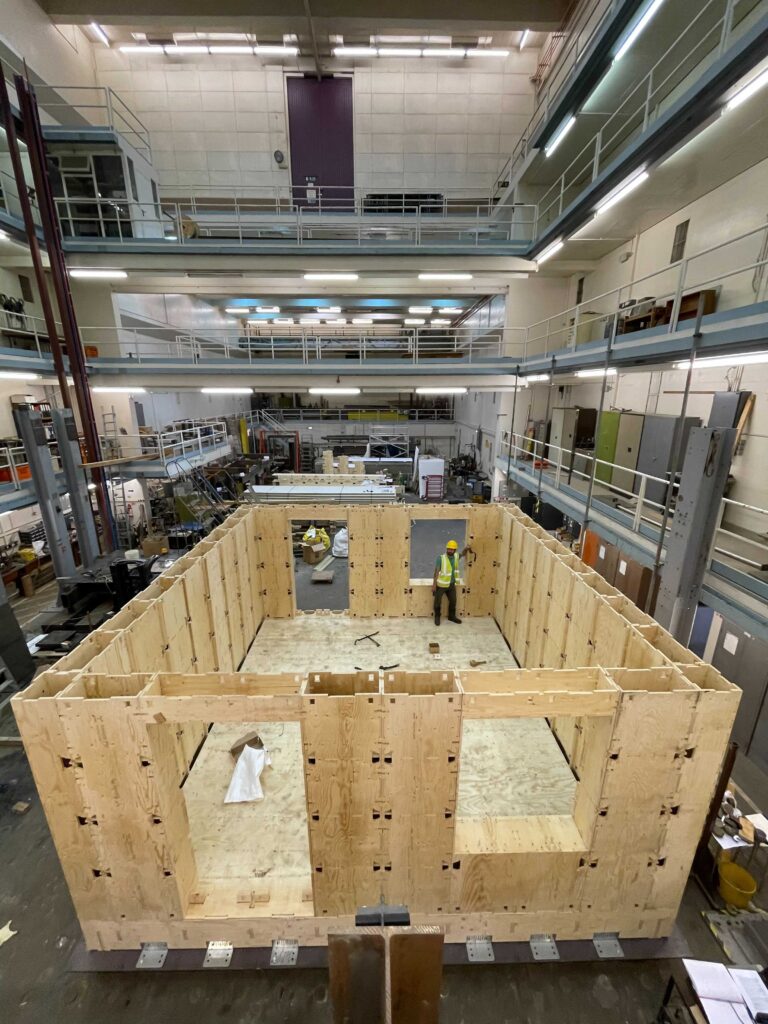
WikiHouse is a construction system that has been continuously developed since 2011 and designed with a holistic approach, involving a great deal of engineering work. It does not aim to improve old solutions but rethinks the entire construction process from the ground up, considering the building’s performance throughout its lifetime and the satisfaction of its inhabitants’ needs.
Although wood is a traditional building material, new dimensions of its use have emerged over the past decade. On the one hand, for environmental reasons, and on the other, with the spread of engineered laminated timber structures, they have become credible competitors to both reinforced concrete and steel structures. With the spread of CNC, prefabrication is increasingly important in the construction of timber structures.
Credit: Open Systems Lab and Credit: Jack Watts
From Structure to Construction
The supporting structure is the skeleton of the house, which carries the cladding and contains the mechanical and electrical wiring necessary for operation. In “traditional” construction, inaccuracies in the supporting structure impair the quality of the structures placed on it – in the system we use, this can be minimized.
The supporting structure of a WikiHouse building is designed similarly to the self-supporting chassis used in the automotive industry, where strength is provided by a structure forming a transition between the shell structure and the space frame.
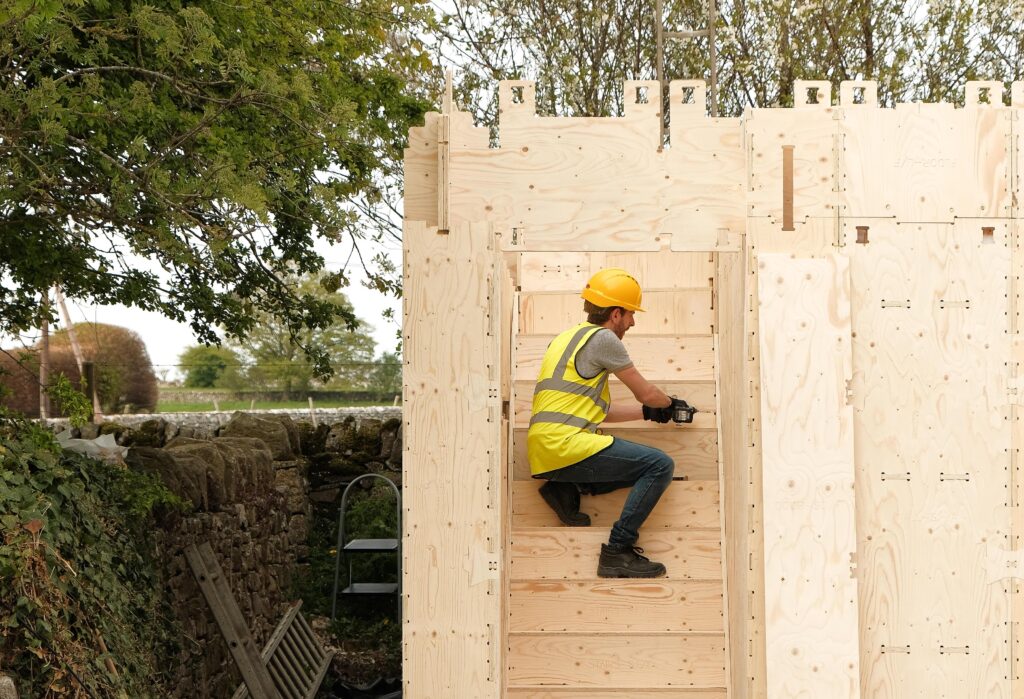
The WikiHouse structure can be assembled in a few days or even a few hours, even by a team without traditional construction experience. However, remember that a functioning house requires much more, such as mechanical systems, electrical networks, and cladding. It is best to leave these to professionals.
The structural frame of a WikiHouse weighs much less than that of a traditional building, making it easy to transport and assemble while remaining extremely strong. An average wall panel weighs only 39 kg but can withstand a load of 13 tons, equivalent to the weight of three elephants. We do not recommend testing this, as elephants would not approve.
Success Lies in the Details
The blocks we manufacture already achieve a U-value of 0.14 W/m²K on their own, which can be further improved while maintaining excellent airtightness.
Thanks to the traditional plasterboard structures used in the layer sequences, WikiHouse walls have a fire resistance of 90 minutes (REI 90), while floors and roofs have a fire resistance of 60 minutes, according to the fire resistance certificate issued by the system developer.
The construction of an average new brick house produces approximately 300–500 kg CO₂e/m² of carbon dioxide emissions. By using the WikiHouse system recommended by Home 4.0, emissions can be reduced to 100 kg CO₂e/m² under the same parameters.
Design and build your own
WikiHouse with us.